
Double girder crane
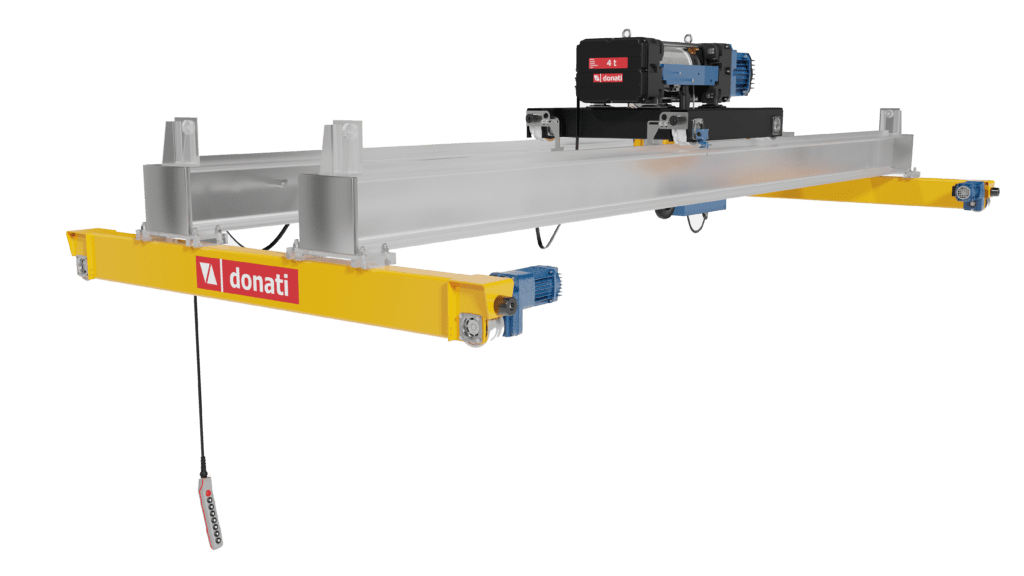
Double girder crane
A double girder crane is an overhead crane configuration where the bridge consists of two parallel girder beams supported by end trucks. This design offers several advantages over single girder cranes, especially for heavier lifting applications and more demanding environments:
- Structure: The main structural feature of a double girder crane is its two parallel girder beams that span the width of the crane. These girders are typically connected by cross-bracings and support the trolley and hoist mechanism.
- Lifting Capacity: Double girder cranes are capable of handling heavier loads compared to single girder cranes. This is because the load is distributed between the two girders, providing increased stability and capacity.
- Height of Lift:Double girder cranes can achieve greater hook height (lift height) than single girder cranes, which can be beneficial in facilities with high ceilings or where vertical lift is critical.
- Durability and Stability: The dual girder design enhances the crane's stability and durability, making it suitable for more rigorous and frequent use in heavy industrial applications.
- Control Options: Double girder cranes often offer more advanced control options and configurations, allowing for precise positioning and control of heavy loads.
- Applications: Double girder cranes are commonly used in industries such as steel mills, heavy manufacturing, shipyards, and other environments where heavy-duty lifting capabilities are required.
- Maintenance: While double girder cranes can be more complex than single girder cranes, they are designed with accessibility in mind for maintenance and servicing.
However, it’s important to consider that double girder cranes are generally more expensive and require a higher initial investment compared to single girder cranes. The choice between single girder and double girder cranes depends on factors such as required lifting capacity, span, duty cycle, and specific operational needs of the facility.