
Jib crane
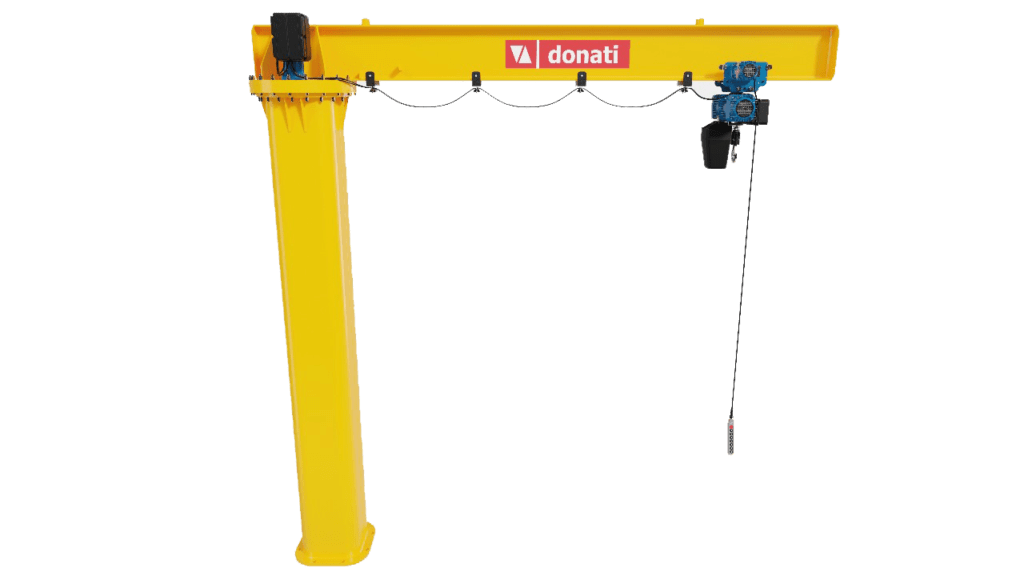
Jib crane
A jib crane is a type of crane where a horizontal arm (jib or boom) is mounted to a vertical mast or wall. The arm can rotate horizontally around the mast, providing a versatile and flexible lifting solution for a variety of applications. Here are some key features and characteristics of jib cranes:
- Structure:
- Mast: A vertical support structure that is either freestanding or mounted to a wall or column.
- Jib/Boom: A horizontal arm that extends from the mast. It can rotate horizontally, typically through a limited arc (e.g., 180 degrees or 360 degrees), depending on the design.
- Hoist: A lifting mechanism (electric chain hoist or wire rope hoist) is attached to the jib/boom, allowing for vertical movement and lifting of loads.
- Types:
- Free-standing jib crane: The mast is freestanding and supported by a heavy base or foundation. It does not require attachment to a building structure and can be relocated if needed.
- Wall-mounted jib crane: The mast is attached to a wall or column, saving floor space and providing a more compact lifting solution.
- Applications:
- Workstations: Used for lifting and moving materials within a specific workstation or area of a facility.
- Loading docks: Can be used to load and unload materials from trucks or containers.
- Assembly lines: Facilitate the assembly process by positioning components or products.
- Maintenance and repair: Ideal for tasks that require precise positioning and maneuverability of tools or equipment.
- Advantages:
- Versatility: Jib cranes offer flexibility in handling materials and equipment within a confined space.
- Cost-effective: Generally more affordable than larger overhead bridge cranes, especially for lighter lifting capacities.
- Easy installation:Typically easier to install and require less structural support compared to overhead bridge cranes.
- Limitations:
- Limited reach: The lifting radius is limited by the length of the jib/boom.
- Capacity:Jib cranes are typically used for lighter to moderate lifting capacities. Larger capacities may require heavier-duty models or other types of cranes.
Overall, jib cranes are valued for their efficiency, flexibility, and ability to improve productivity in various industrial and commercial settings. The choice between a free-standing or wall-mounted jib crane depends on factors such as available space, load requirements, and specific application needs.